|
| Ed Osborne |
|---|
| Over the course of over eleven days in April, SoundCulture 96 landed in the San Francisco Bay Area. The festival included 17 exhibitions, 10 panels, and 55 performances and other events held at 33 sites throughout the Bay Area. Co-presented by 32 Bay Area arts and culture organizations and including the work of 228 artists from the US, Canada, Japan, Australia, and New Zealand, SoundCulture 96 was easily the largest sound art event ever held in the United States. As the director and one of the participating artists, I can hardly be objective about the SoundCulture 96; this is an overview of the festivities from someone who knows the event inside-out. Focused on the creative use of sound outside of the field of music by practitioners based in the Pacific region, the festival was planned to include representation of a number of differing areas of sound practice: sound sculpture and installations, radio and telephonic works, performance, acoustic ecology, noise, cultural theory in relation to sound, appropriation, high- and low-tech activities, educational events for kids, homemade sound instruments, sound works for public space, sound for film, and so on. All of these areas existed in some form or another in the festival. In the space here, there is only room to mention a few of the many events and to illustrate some of the broader themes that emerged from SoundCulture 96. |
|
|
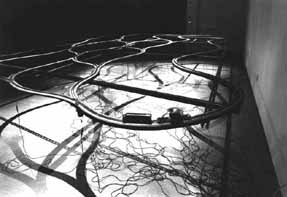
While Ron KUIVILA worked with the latest in surveillance cameras, crackling wires, and custom digital signal processing, and Negativland employed a cryptic array of subversive electronics in conjunction with a pair of techno DJs, Julaine STEPHENSON rewired a washing machine to play clean a 7" vinyl disk, and Phil DADSON drew sound out of hand-operated stones, some of which dated back to the Paleolithic era. And where Ian POLLACK and Janet SILK's "Museum of the Future" was driven by computer and heard over telephone lines, MIZUSHIMA Kazue's "Eve of the Future" employed silk thread and paper cups to deploy a vast array of string telephones across an outdoor lawn space in which she performed by stroking, scraping, and occasionally breaking the threads. This wide array of kinds of work was matched by the variety of circumstances in which the work was found. It was possible to venture to find SoundCulture events in museums, universities, non-profit and commercial galleries, performance spaces, warehouses, on a beach, on radio waves, in a shopping mall, in a harbor, in a cinema, on a public transit bus, on the Internet, and in nightclubs. |
Given that the geographic scope of SoundCulture is centered on the Pacific's "Ring of Fire," it was no surprise that fire showed up literally and metaphorically in a number of works. Scot JENERIK gave an energetic performance in pummeling a pair of flaming structures wired for sound. Tony MACGREGOR and Virginia MADSEN's "Cantata of Fire," broadcast on KPFA, looked at the audio culture of the siege at Waco, Texas and the fire that concluded it. In Richard LERMAN's "Changing States," a tiny flame was used to heat metal strips attached to contact microphones. As the metal deformed in slow and unpredictable ways under the heat, its eerie transformations were heard greatly amplified. Evoking at once the micro-world of the grain of metal and the macro-reality of plate tectonics, the piece served as an allegory for the process of generating sound itself: sound like fire is simply an artifact of the transfer of one form of energy into another, expended in an instant and then gone. Later in the evening, Lerman showed a videotape of a swarm of desert ants crawling over a pair of microphones. The high gain on the recording devices again reversed the micro and macro, and as these tiny creatures produced enormous sounds, their energetic activities seemed to be asking us to consider how much these microphones were in service of our intentions and how much we instead worked to fulfill theirs. |
|
Later that day, a panel session on the subject of acoustic ecology touched on some of the issues raised in Wettrich's piece: control of social space, preservation of quiet, the harnessing of natural sounds for artistic and commercial purposes. Hildegard WESTERKAMP, one of the foremost figures in the field of soundscape studies, gave an eloquent talk on listening, sound, and silence in relation to personal, local, and global well-being that provided an encompassing view of the way soundscapes can be used to monitor engagement with and connection to our surroundings. Her talk provided a refreshing and well-considered perspective in an area that is often marked by simplistic cultural assumptions about our relation to nature; the spirited discussion that followed the panel presentation centered around these issues. |
| Among the other notable works in the festival were Nigel HELYER's "Silent Forest," an installation of beautiful sound horns modeled on those found on the Saigon opera house and used as air raid sirens that broadcast distended abstracts of opera music found in colonial Vietnam. Jack OX presented her stunning visual score derived from Kurt SCHWITTERS' influential text-sound work "Ursonate" on the West Coast for the first time. Ellen BAND showed an installation focusing on subtle, psychoacoustic trickery. At the Pacific Film Archive, a series of events examining sound in film included (among other events) an evening of sound works by filmmakers played entirely in the dark, a lecture by Douglas KAHN on sound and audio art relating to film in the first half of the twentieth century, and an illustrated talk on the development of film sound by Robert GITT of the UCLA Film and Television Archive. A listening room located in the San Francisco Art Commission Gallery allowed visitors a chance to hear a wide variety of recorded sound work from around the Pacific. |
| GREETINGS | SOUND
CULTURE: Ed Osborne |
KOSUGI Takehisa essay | NAKAGAWA Hiroshi | GAMELAN EXPERIMENTS | CARL STONE |
| Back to Carl Stone Home | Back to Xebec Home | ||||
|---|---|---|---|---|---|